Index
04/15
Year
2025
Role
Creative Developer
Read
4 min
746 wordsMedia
6 items
Stack
Data Visualization · Market Sentiment · Generative · Particle · Interactive · WebGL · 3D · Audio
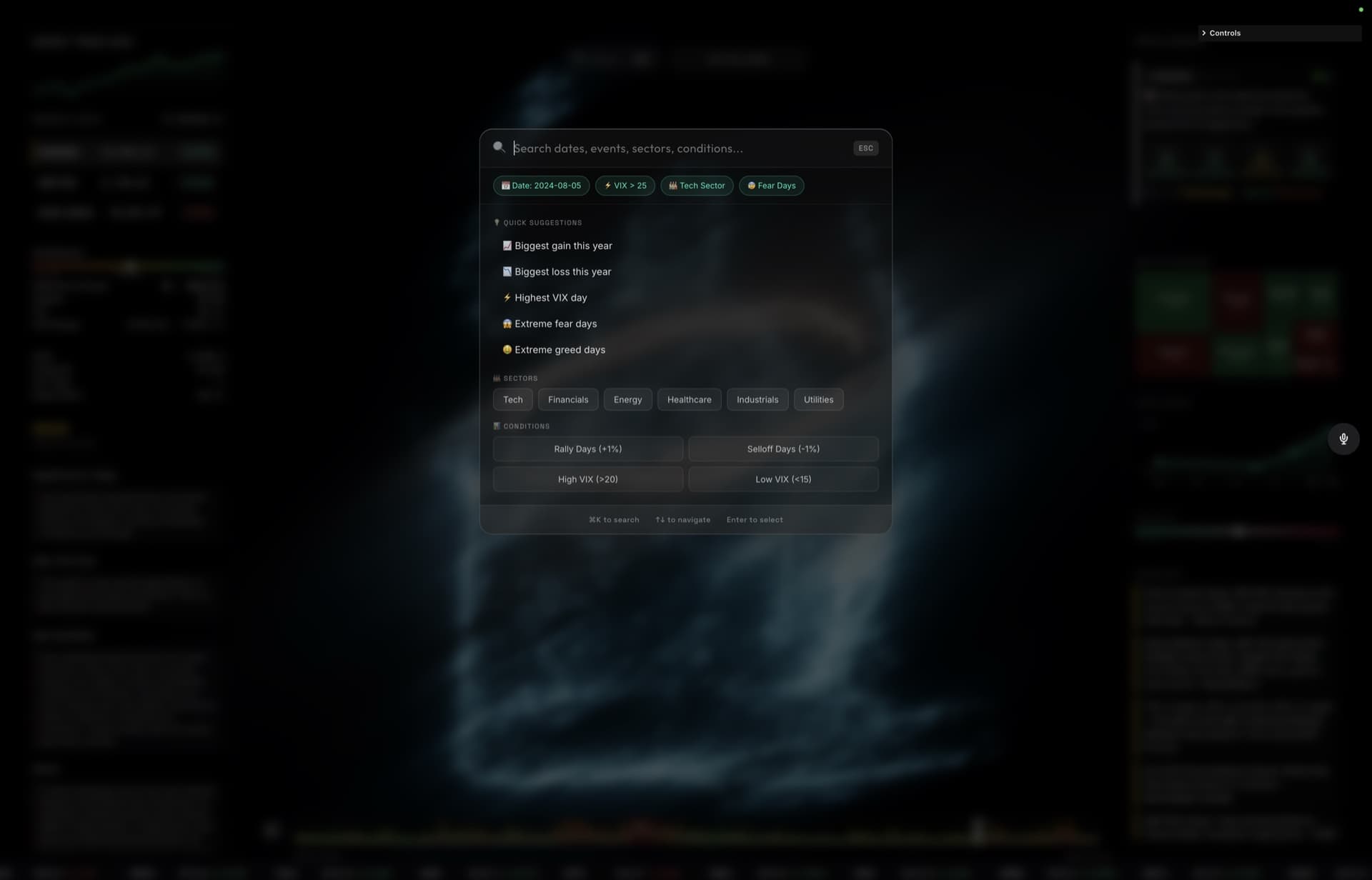
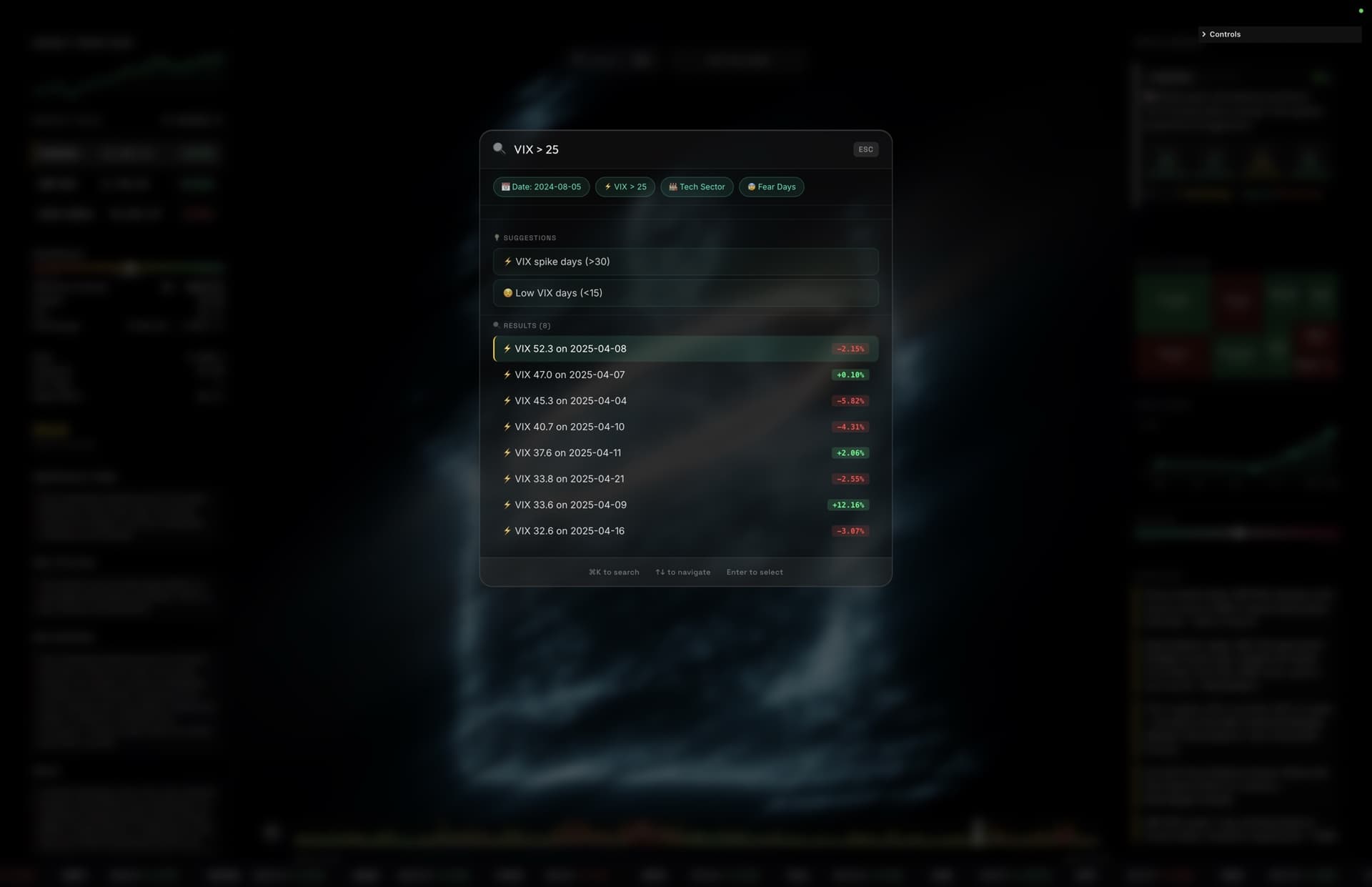
Markets repeat themselves because participants do. This project reframes market sentiment as collective memory — visualizing the emotional patterns of fear, optimism, and overconfidence through thousands of GPU-driven particles that dissolve into Greek deity sculptures, each assigned by a data-driven classifier reading real Fear & Greed indices, VIX, and trading volume.
Live Experience
Interact with GPU-accelerated particle systems directly below — hover and click to disturb thousands of particles flowing around 3D masks in real time.
Markets as Collective Memory
As financial markets lower barriers to entry, participation expands beyond professionals to emotionally engaged investors worldwide. Markets are no longer driven only by fundamentals — collective psychology, online discourse, and rapid sentiment shifts now shape price action. Yet while access to real-time data has improved dramatically, tools for reflection and long-term emotional understanding remain absent. This project responds to that gap by reframing market sentiment as a form of shared memory rather than a transient signal. Instead of treating emotion as noise to be filtered out, it acknowledges sentiment as a primary force shaping market behavior. When emotional history is invisible, mistakes feel new each time. The ability to remember — not just react — becomes a critical form of literacy.
Ruling Deities — Why Greek Gods
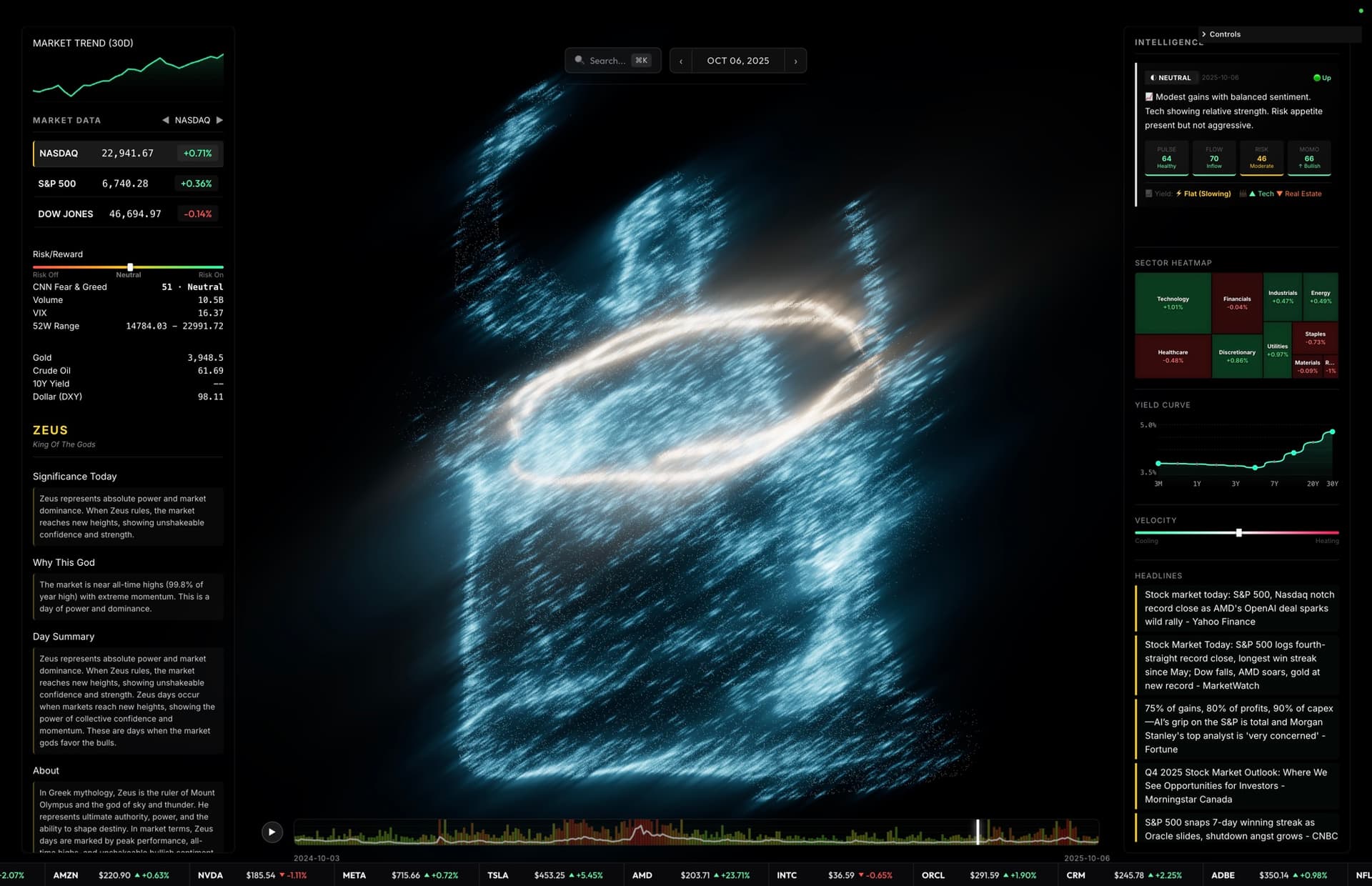
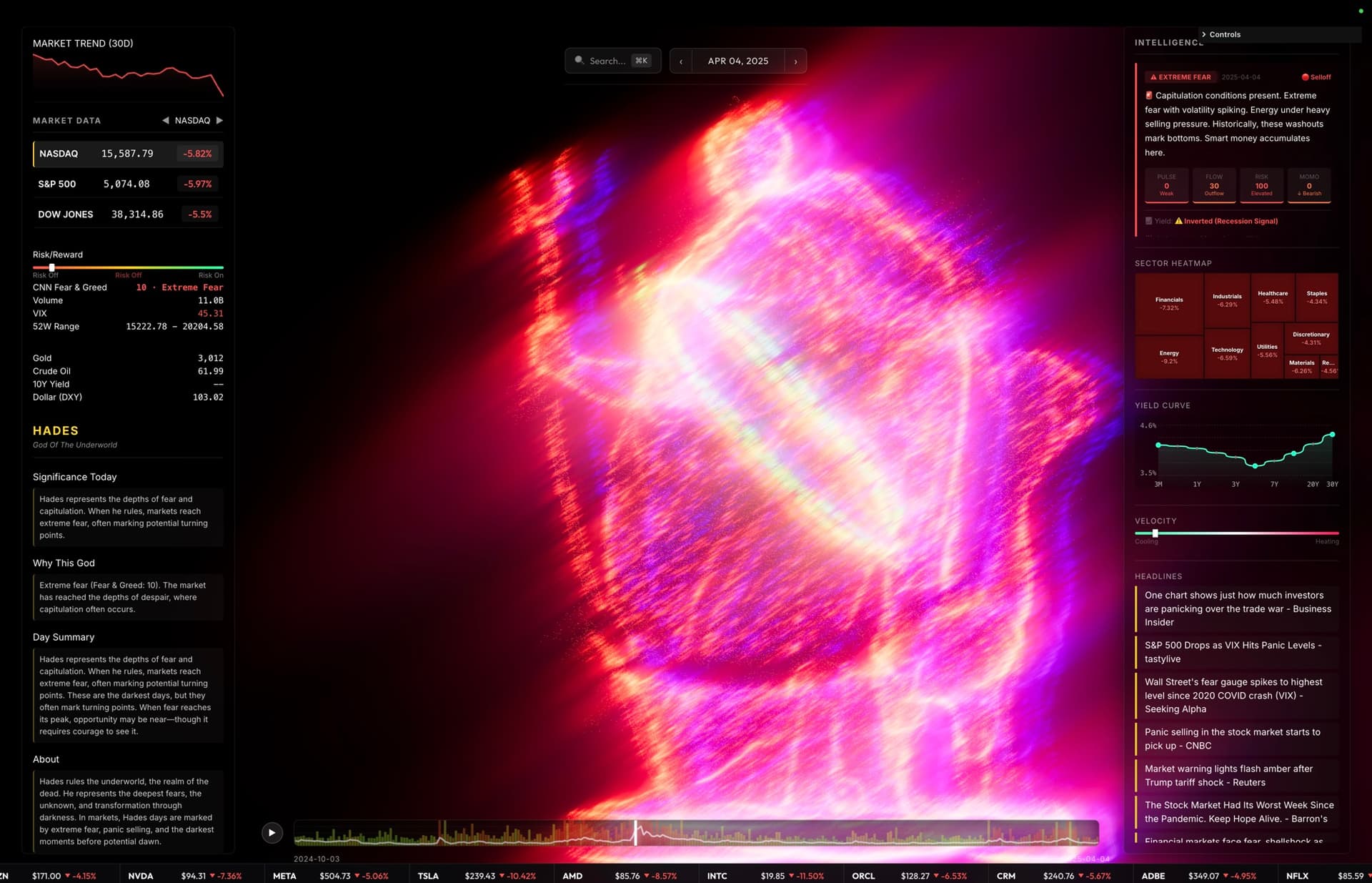
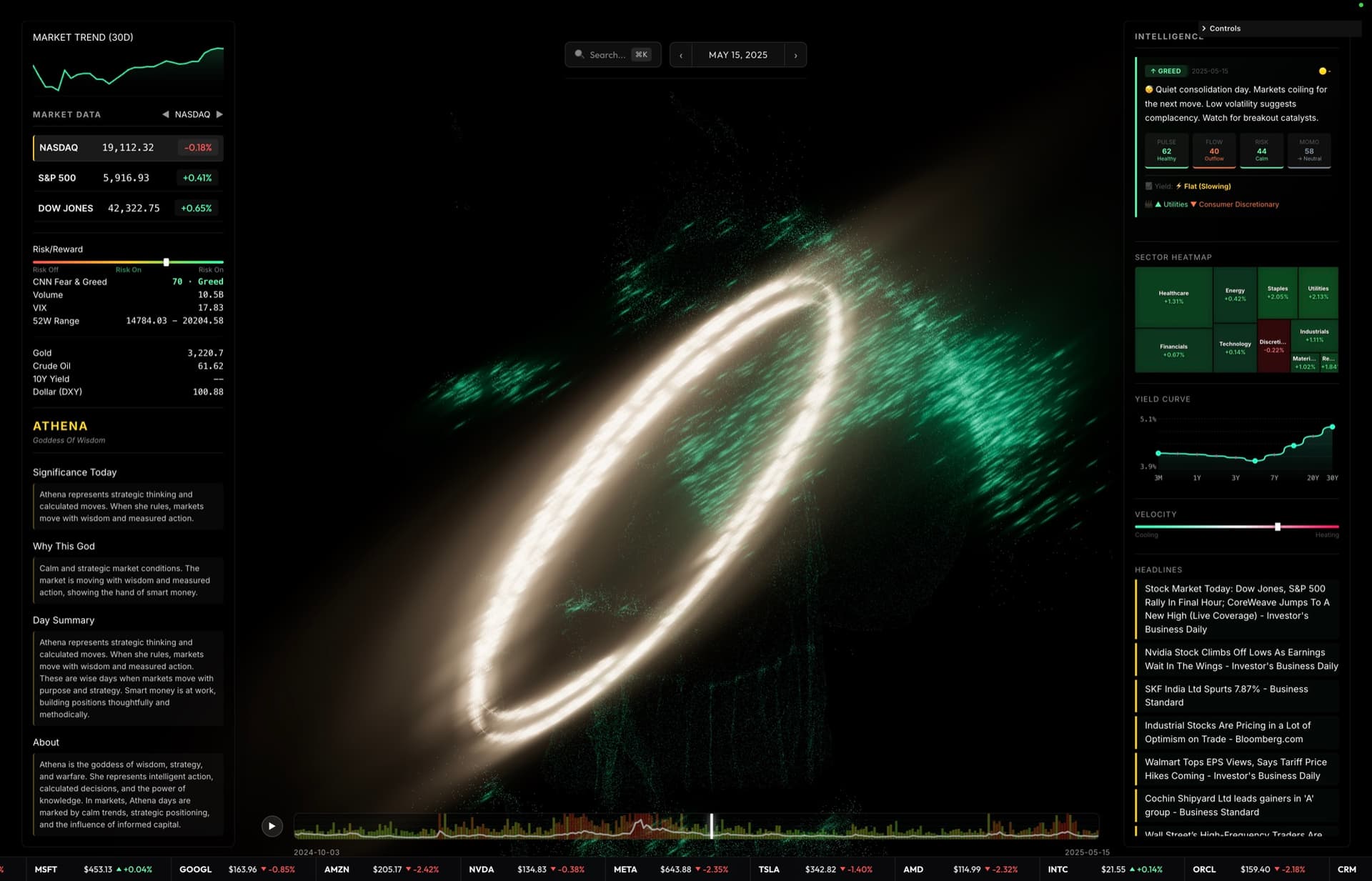
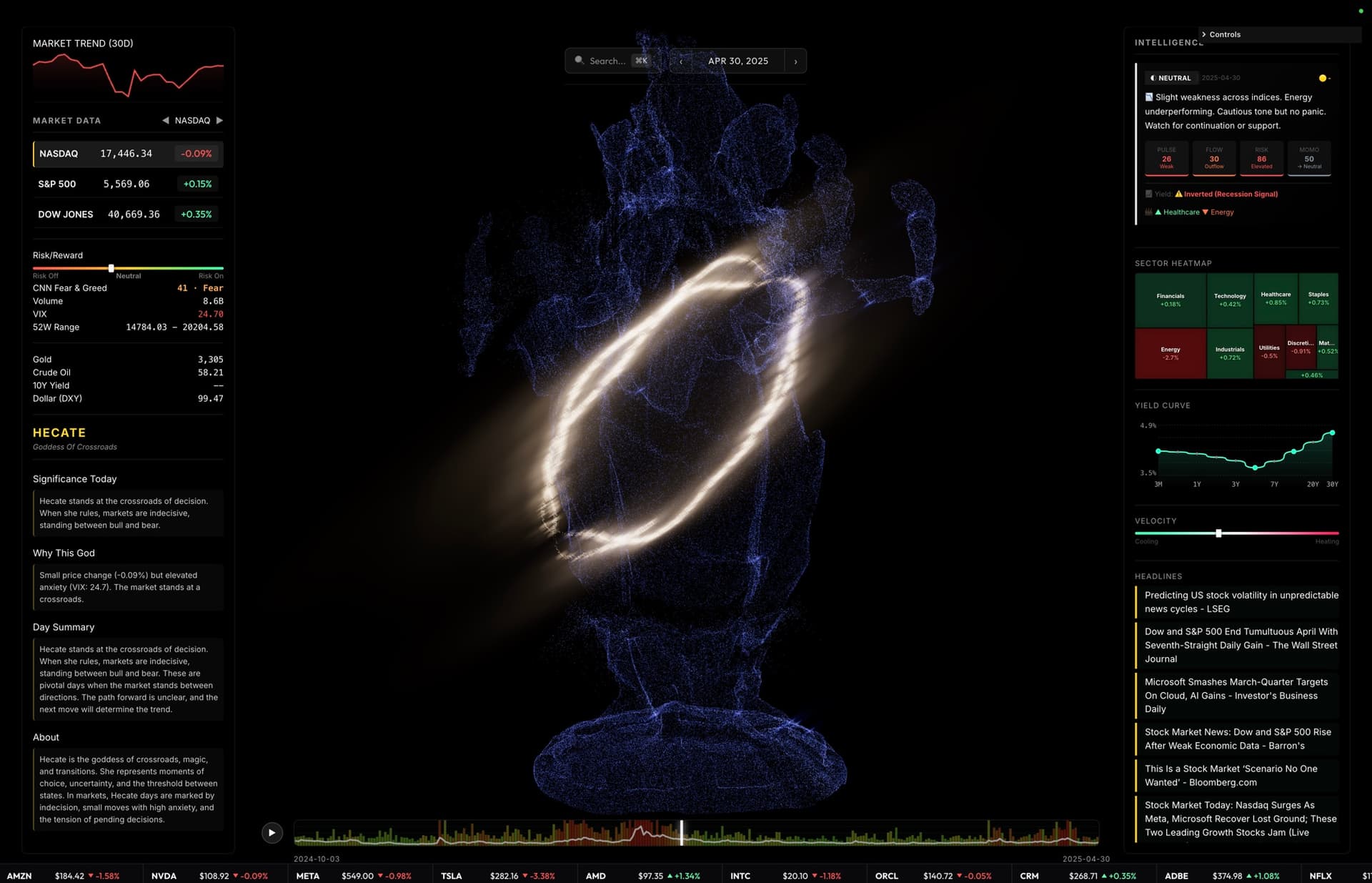
Every trading day is assigned a ruling deity based on measurable signals: Fear & Greed index, VIX, daily percentage move, volume ratio, RSI, intraday range, and proximity to 52-week highs/lows. Markets behave like archetypes — fear, greed, chaos, recovery — and gods are a shared shorthand for those forces. Zeus appears near year highs (dominance, peak confidence). Dionysus signals mania when extreme greed meets overbought RSI. Poseidon arrives on deep red days with high volume (liquidation waves). Hades marks capitulation at extreme fear. Athena is the default — measured, strategic behavior when no extremes hit. The myth is the label; the data is the reason. 'Poseidon day' sticks more than '-2.1% high volume selloff.'
What the Particles Mean
Instead of drawing the market, I let it behave like a living system. Thousands of GPU-computed particles form 3D deity sculptures — their cohesion and fragmentation become a visual language. Tighter formation reads as stability, agreement, and structure. More agitation signals stress, disagreement, and volatility. Sudden ripples convey events, shocks, and collective reaction. A tilted, rotating WordRing of poetic text orbits each deity — numbers tell what happened, words tell how it felt. The ring's rotation angle encodes a 12-type regime signature, giving each day a subtly different identity before you even read the text.
Data Pipeline
A Python pipeline (yfinance) fetches 2 years of historical data across 20+ tickers — indices, sectors, commodities, and tech stocks — then computes 20+ technical indicators: moving averages (125/200-day), RSI, volume ratios, 52-week ranges, yield curves, and sector performance. CNN Fear & Greed API provides real sentiment scores; Google News RSS supplies daily headlines anchoring each day's mood in real-world context. Rather than feeding raw prices into visuals, the pipeline transforms inputs into features, then classifies each day in an explainable way — every label has a reason you can point to. Python prepares the truth; the browser renders the art.
Audio & Interaction
Five mood-matched audio tracks (Extreme Fear, Fear, Neutral, Greed, Extreme Greed) drive the visualization through real-time FFT frequency analysis. Bass (20–140 Hz) affects particle size and movement, mids (400–2600 Hz) shift color, highs (5200–14000 Hz) control brightness. A VIX-based distortion overlay adds sonic tension. The 3-phase hover system creates distinct interaction zones — a white-hot core, a pulsing mid-glow, and a speed-sensitive outer halo. Tap ripples accumulate energy like escalating shocks. Enabling the webcam adds a human presence layer: brightness and contrast from the feed become a soft force field nudging particles, making the piece feel like an installation where the physical environment influences the digital system.
Technical Challenges
Loading 5+ 3D deity models caused 5–10s initial load times — solved by lazy loading only the primary model and loading others on demand, cutting load to under 2 seconds. Model switching took 2–3s for particles to consolidate — fixed with dynamic shader uniforms, precomputed texture caching, and a high-attraction/low-force formula achieving < 0.3s snap time. Extreme market conditions were making visuals too dark because amplitude shifted the baseline — solved by maintaining a constant midpoint and only increasing the range of variation. WordRing text was rendering upside down and overlapping — iterative refinement of cross-product vectors, tilt angles (30° → 40°), and spiral path generation produced readable, properly oriented text.
Tools Used
Web Development · 2025